
Ya basic, Sarah
A shallow dive into what I read in 2025

Happy new year! Apparently we are not taking 2026 in a saner direction than last year, but I still have hopes that we can turn it around! In the meantime, if you’re able, please consider donating to an organization such as RAICES that supports legal and social services for immigrants and asylum seekers in the US.
I’m not a huge numbers person. Shocking in a novelist, I know. However, my book club recently chose our books for the next year (we do it all in one go, highly recommend) and I was struck by the number of suggested books that were by already-somewhat-huge authors. My book club is made up of women who read multiple books a month and actively seek out new authors, and the fact that the selections were so mainstream highlights a discovery problem in publishing that I’ve been thinking about for a while.
People are forever complaining on social media that “nobody writes” books about X or “there are no books” that feature Y. I promise you at least one book exists that will scratch your specific itch (I mean, we’ve got romances that feature cannibalism, how hard can it be to find a tall FMC). They’re just hard to find because even avid readers discover books through best-of lists, or algorithm-fueled social media, or celebrity book clubs, and all of these tend to promote books and authors that are already successful on a larger scale. Not only does this overshadow great books that perhaps have not been marketed as well as they could (or didn’t have a shiny enough “hook” to justify marketing spend, which doesn’t mean they are not wonderful!) but it reproduces hierarchies of privilege that have been baked into publishing for many decades.
I got curious about how diversely I actually read in 2025 (as opposed to books I added to my TBR, which is aspirational and infinite) on several dimensions.
Methodology
My sample is the 1001 books featured in my “monthly reads” posts on Instagram from 2025 (I did read other books but for the most part they were either research or DNFs). I plugged everything into a Google Sheet and made an ugly-ass chart. I have some professional experience in statistics and infographics but not nearly enough to make this more than a personal project. Statistical errors are on me.
Dimensions
Books by BIPOC authors
I’m fairly plugged into the book world and I make a conscious effort to read books by authors of color and queer-identifying authors. If you don’t make that effort, it’s all too easy for your TBR to end up looking like the 2025 winners of the Goodreads Choice Awards. (This is Goodreads’ annual reader-driven ranking, and in 2025, as in almost all previous years, most of the winners were white, straight-presenting authors.) If a book’s author was identifiable as belonging to a BIPOC community, I counted them as part of this group.
Non-bestsellers
I was also curious about how many books I was reading that were not at the top of the mainstream, as demonstrated by their presence on bestseller lists. Fiction bestsellers are a tiny percentage of books published, but for obvious reasons tend to be the most purchased/read. I wanted to know how deep I was digging. I counted a book as a “non-bestseller” if I could not find information that indicated it had appeared on the New York Times, USA Today, or Sunday Times bestseller lists at any point.2 (Amazon has a million obscure “orange banner” bestseller categories which makes it a bit too messy to figure in here.)
Debut novels
It’s often difficult for debut authors to “break out” as they don’t have an existing audience. I have a feeling this is why we’re seeing so many traditional publishers buying up the rights to very successful self-published authors’ books (cases in which the author has taken on the risk, effort, and expense of building an audience). I counted a book as a debut if it was the first one published under that author’s name. (I did not count books as debuts if the author previously published a story collection, or in a different genre or age category, under the same name.)
“New” books
Reading older books is pleasurable and necessary (I went on a tear through some of L.M. Montgomery’s work last year, and I would not be the writer I am today without Octavia E. Butler, Madeleine L’Engle, or Margaret Atwood) but since starting to publish fiction I have been reading a lot more recently-published books. This supports currently working writers, though there’s also a lot to be said for discovering a new-to-you author’s backlist.
For the purposes of this analysis, a “new” book was one published within the last five years (pub date in 2021 or later).
LGBTQ-identifying authors
I quickly realized that determining whether an author identifies as queer is more complicated than taking a glance at their bio,3 so I abandoned this as a quantitative measure since there wasn’t much hope of getting an accurate tally. Maybe if I wanted to do a deep dive into people’s social media and interviews, but this project didn’t really justify spending that amount of time on research and also it felt like that would be a bit…creepy? So while I did note for myself books whose authors identify as queer in their bios or very clearly in social media, just to keep track of that representation in my reading list, this dimension is not included in my analysis.
On to the graph!
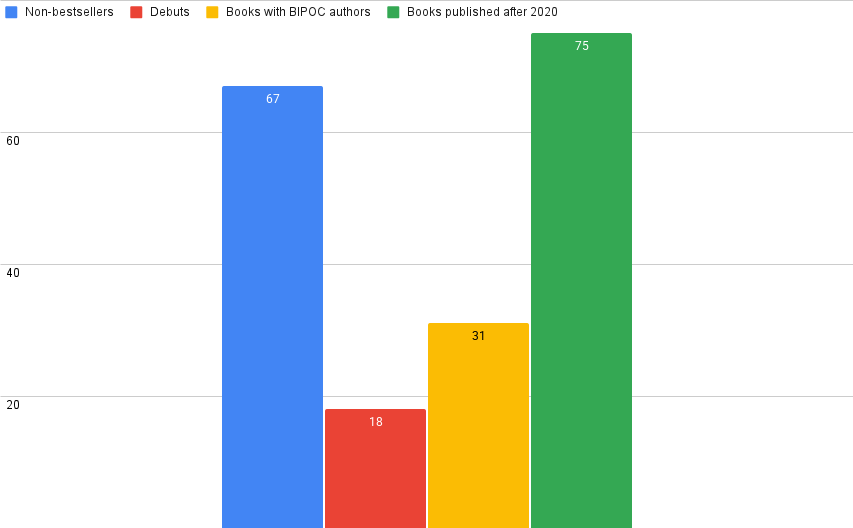
For the non-visual among us (me included):
67 out of 100 (which conveniently calculates to 67%) books I read were non-bestsellers
18% were debuts
31% were by BIPOC authors
75% were published within the last 5 years
So what does it all mean?
Obviously I can do better at reading diversely and taking a chance on authors I don’t know, but what else is this chart communicating? That I’m a nerd? That I’m procrastinating actual writing by playing with spreadsheets? Who can say?
What’s the recipe for reading more “obscure” or “underrated” or “niche” books? (All of those words give me hives btw.) Especially in genre fiction and more commercial/upmarket spaces, it can be tough to discover books that aren’t getting the lion’s share of hype, even if one is tuned into the publishing world.
It helps to seek out those books in the (woefully few) spaces where they are actually promoted. In the SFF area, I’ve been going through Locus’s extensive review backlist and have added many books to my (again, infinite) TBR that I missed when they first came out. If you’re okay with doing a little further research (or picking up a book based on a cover and short blurb — libraries are great for this) there are many bookish websites that publish listicles or have tagged archives featuring books that may have not scored dedicated reviews in an ever-shrinking book review landscape.
I could say a lot about the dwindling of book coverage (and reading for pleasure in general) and how that might correspond to the dwindling midlist, but I have a limited perspective and others have already yapped more eloquently and knowledgeably on those topics. I will say that just because a book isn’t on a front table at your local B&N or hasn’t climbed the bestseller lists doesn’t mean it’s not worth reading. If you’re willing to dig a little, you may discover a new favorite author.
Reading/watching/listening
Reading: I’ve got Holly Brickley’s DEEP CUTS going on audiobook which was the right decision for a book so intensely about music. I’ve been pausing to listen to all the songs mentioned within the text (Brickley has thoughtfully provided a playlist) which really deepens the experience.
I tend to have issues with music books, not because of inaccuracies but because they stir up my own lingering impostor syndrome as a recovering retired musician. So this may be the first novel I’ve read that really delves into the early 2000s/indie sleaze era4 and hoooo boy are some of those interpersonal and gender dynamics familiar in a lowkey traumatic way lol.5 But I’m enjoying the voice and Percy’s journey so much. Jayme Mattler’s narration has just the right amount of sardonic empathy to ground this coming-of-age/love/creative collaboration-slash-obsession story.
Watching: Like the entire rest of the country I watched the Stranger Things finale (during a literal fever dream since my apocalyptic flu was just ramping up on NYE) and found it satisfying!
Listening: My husband and kid both recently played Dispatch which introduced me to THOT SQUAD aka Blvck Bunnie, who raps as well as voicing the character of Prism (canonically from my hometown of Flint, MI!)
If you enjoy my ramblings, you might like my books!
The Other Me, which PopSugar called a “Black Mirror-esque rabbit hole,” is an inventive page-turner about the choices we make and the ones made for us.
When I’m Her asks the question: How far would you go to get even with the woman who ruined your life?

I didn’t set out to make my “books I enjoyed in 2025” list number exactly 100 but I am way too pleased with the fact that it does.
I did not go trawling through years of actual bestseller lists, but relied on the fact that publishers love to shout about it when a book makes a list.
Identifying books by disabled authors was similarly complex.
We did not call it indie sleaze at the time, and fortunately the book hasn’t yet either.
The one emotional support “lol” I’m giving myself this newsletter. **kisses you on the forehead** I recommend checking content warnings for this book before you read
I love reading through these metrics of your own reading!! You're inspiring me to do something similar . . .
I’ve made a commitment to read more indie authors this year since I am publishing my debut in the indie realm sometime this year. (Hello, fellow Michigander! I’m originally from Saline!)